
ROOTKIT://死
EXTRACTION RUNNER
SCROLL DOWN
EXTRACTION RUNNER
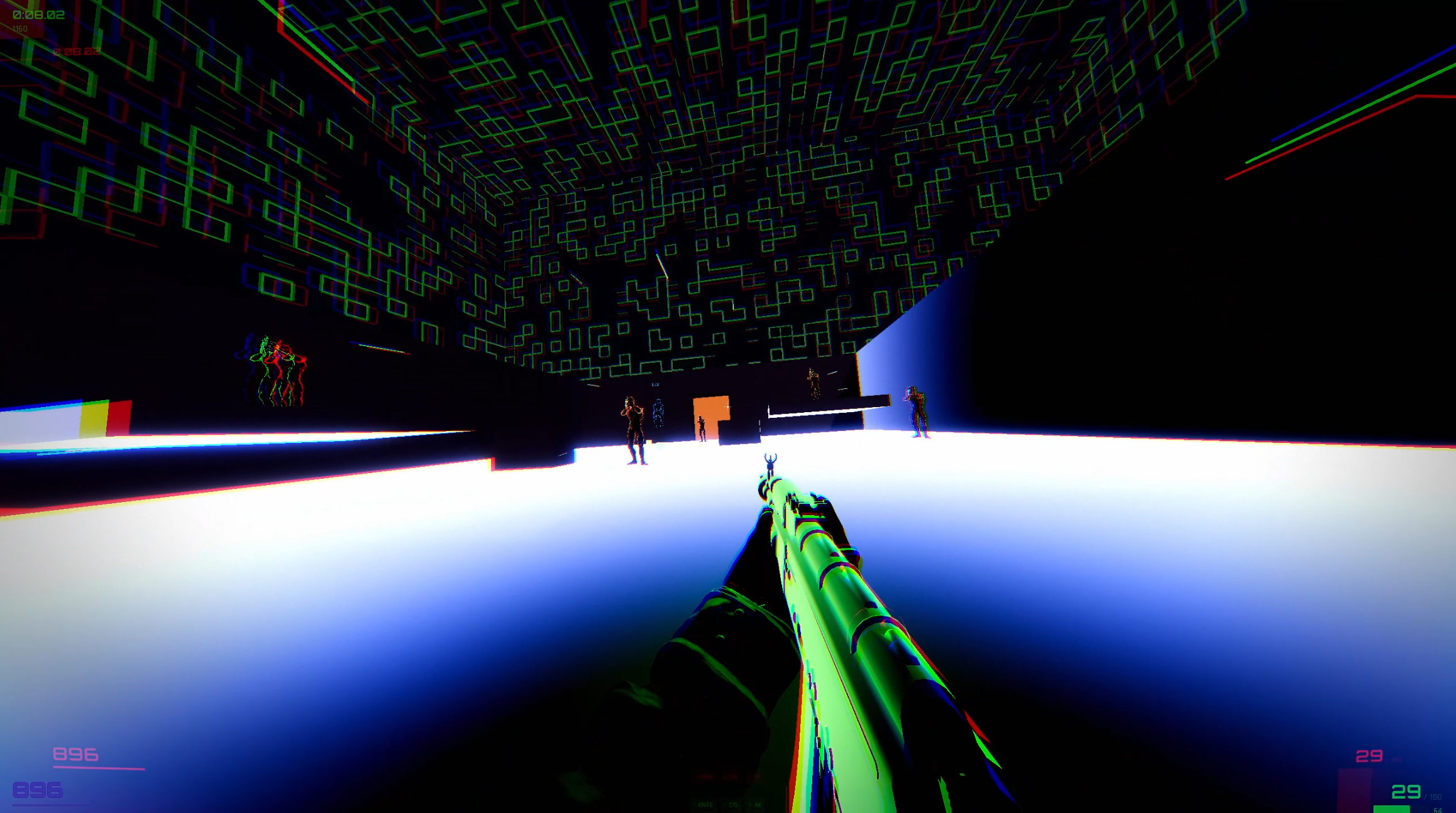
ROOTKIT://死 is a first-person extraction runner. You spawn inside a hostile sector, PMC kill teams already closing on your position. Grab guns, grab health, reach extraction before the system locks you out. Every sector is a timed sprint through converging gunfire and architecture that reconfigures to box you in.
The reason any of it works is the movement. It runs on the same air acceleration model that created bunny hopping in Quake. 30 u/s air cap. When you strafe into a turn, the dot product between your velocity and wish direction hits a window small enough to add speed on every air frame. Hit the window, accelerate. Miss it, don't. No sprint button. No dash cooldown. Your speed comes directly from how well you handle the physics.
If you've surfed or run KZ maps, your hands already know what to do. If you haven't, expect to spend the first sector learning what the floor costs you. Ground friction eats velocity. Every frame you spend grounded is speed lost. Jump. Keep jumping. Learn to read the ramps, because a crouch-bhop on the right downslope converts your vertical velocity into horizontal and that's where the real numbers start.
There are no difficulty options. Every enemy uses the same targeting system. How hard they are to survive depends on how fast you're moving.
Below 200 u/s, aim is perfect. Every round connects. You will die before you identify the shooter. This is what happens when you stop, when you land flat, when you eat a wall. The game punishes deceleration immediately and without exception.
200 to 450 is where you can fight. Enemies track you here but they lead shots and miss around corners. If you can aim while strafing you can hold ground, clear rooms, grab what you need. Most of your early deaths happen in this range while you learn the routes. You'll die on a doorframe that clipped 40 u/s off your speed. You'll die because you stopped to pick up a shotgun. You'll die on a flat landing that dropped you to 180 for two seconds. Then you'll start routing around those spots.
Above 500, shots start going wide. At 550 they're shooting where you were two frames ago. At 600, nothing connects.
But at 600 you're also blowing past every weapon, every health kit, every ammo drop. You can't stop for any of it without tanking back into the range where everything hits. So the actual game is routing. Figuring out which pickups you need, which you can skip, and where to bank speed off a ramp so you can grab a medkit without dropping below 400. The best runs look like someone planned every single footstep in advance, because they did.
30 u/s air cap. Ground friction 4.0. Split-step gravity so ramp transitions don't spike you into the floor. 100 tick sim. Crouch-bhop on downward ramps and your vertical velocity converts to horizontal. Hit the right angle and you'll reach 10x speed. There is no cap. The engine lets you go as fast as your inputs allow.
Every run records your ghost. Positions, inputs, weapon fire. Load the sector again and it runs alongside you. First-person playback with full bullet tracers available from level select. Beat your ghost and the new run overwrites it. Lose and you can watch exactly where it pulled ahead and what it did differently.
The sky is a grid. Each cell belongs to whoever's winning that part of the fight. Taking fire turns cells red. Returning fire takes them blue. Kills spike your territory. Grid reassigns every 500 milliseconds. On a clean run the whole sky goes blue. On a bad one it bleeds red above you while you're looking for the exit.
Enemies call contacts on open comms. Past 450 u/s the callouts get shorter, voices overlap, the tone changes. They're scared. Kill one and the nearest surviving unit says something about it. What they say depends on how far away they were and whether they had line of sight when it happened.
Pellet spread uses a logistic dispersion model from Rios, Thornton & Guarino's 1986 forensic ballistics paper. Cigar-shaped pattern. Tight at the muzzle, widest at 25 meters, then density drops off past useful range. About 15% of pellets deform on discharge from barrel friction and curve outward on parabolic arcs. Point blank puts everything through the same hole. At 30 meters you're gambling on how many connect.
Music runs on a heat system. Shooting adds heat. Getting shot adds more. Kills spike it. Speed keeps a floor under the value, so bhopping alone keeps the track going even when nothing's shooting at you. Hit extraction and the heat maxes out, the track jumps to the 1:20 mark. That section of the song was written for that exact moment in the run.
Sector 0 combat track.
First sector. One block. Five minutes if you fight everything, under two if you know the route.
WISHLIST ON STEAM